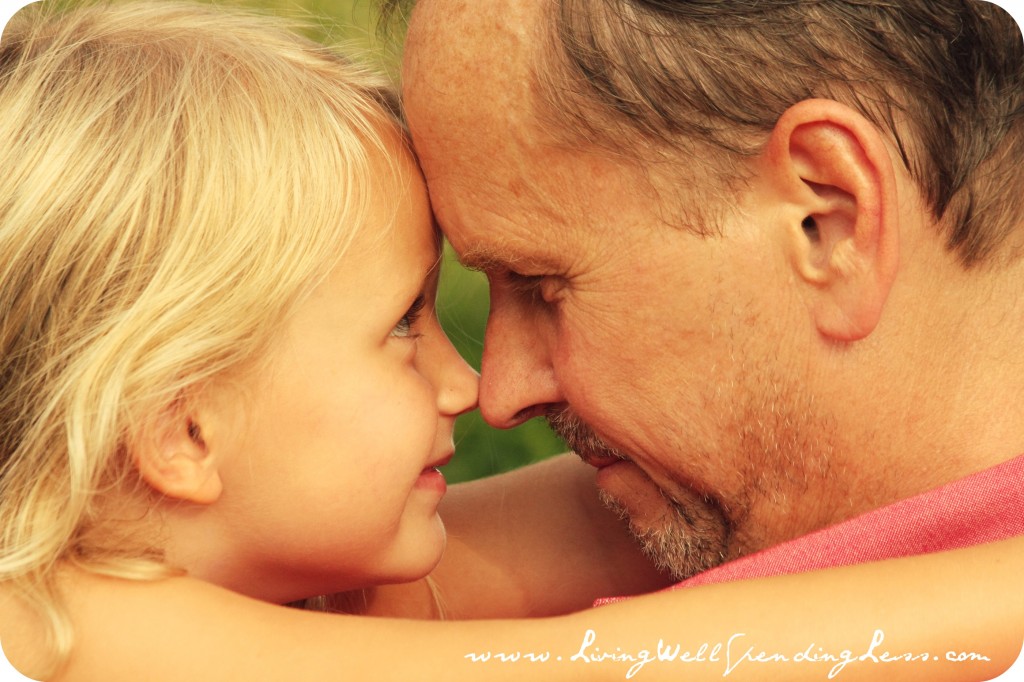
The child gets two loving, hands-on parents.
And curiously, this appears to be a case where not only is two better than one – it works even if, maybe even because, they are different.
Research is constantly suggesting that Dad’s role is important - which may be surprising to some.
It probably should not be surprising. If Nature had decided that human children were better raised by one rather than two parents, she probably would have made it that way. That's how Nature - a.k.a. evolution - works.
There are host of odd findings that show the important influence of fathers on the cognitive and emotional development of their children.[i]
It probably should not be surprising. If Nature had decided that human children were better raised by one rather than two parents, she probably would have made it that way. That's how Nature - a.k.a. evolution - works.
There are host of odd findings that show the important influence of fathers on the cognitive and emotional development of their children.[i]
For instance, fathers communicate less on average with their
children than mothers (that figures given that they are male perhaps), but surprisingly,
they appear to have more influence on the vocabulary than the mothers[ii].
However, more generally, the children of engaged fathers
show more significant gains in intellectual development, better self-image,
more sense of humour, longer attention spans, more eagerness for learning, and
greater resistance to peer pressure.[iii]
Daughters in particular, learn really important emotional
and relationship stuff from their Dads, in particular how to relate to the
other sex. As John Mayer says in his song Daughters, “Fathers be good to your daughters / Daughters will love like you do."
As a counterpoint, it is notable that daughters raised with
stepfathers rather than their biological fathers tend to grow up faster[iv].
In particular, they
-
reach puberty earlier
-
menstruate nine months earlier on average
-
commence sexual activity earlier
-
and tend to become pregnant earlier.
Having two parents seems to have a whole lot of positive
effects and reduces a whole set of risks for children. The evidence for this
comes from the risks that are faced by children raised in single-parent
households[v]:
-
- twice as likely to drop out of school
- twice as likely to drop out of school
- more likely to become teen parents
- more conflict with their parent(s)
- less supervised by adults
- more likely to become truants
- more frequently abuse drugs and alcohol
- more high-risk sexual behaviour
- more likely to join a gang
- twice as likely to go to jail
- four times as likely to need help for emotional and behavioral problems
- more likely to commit suicide
- more likely to participate in violent crime
- twice as likely to get divorced in adulthood
- more conflict with their parent(s)
- less supervised by adults
- more likely to become truants
- more frequently abuse drugs and alcohol
- more high-risk sexual behaviour
- more likely to join a gang
- twice as likely to go to jail
- four times as likely to need help for emotional and behavioral problems
- more likely to commit suicide
- more likely to participate in violent crime
- twice as likely to get divorced in adulthood
Caution ought to be applied in interpreting these
conclusions too simplistically.
Firstly, many of the difficulties faced by
children in single-parent households could be related to economic challenges as
single-parent households tend to have less income than two-parent households.
Secondly, children raised in a two-parent household with one parent
displaying serious anti-social behaviour are generally worse off than those
raised in a single-parent household with the the non-deranged parent of course.
However, all in all, Dad’s involvement is clearly of benefit to the
children.
[iii] Ladd,
Linda D. (2000) “Fathers are Important—For Real!” Texas Cooperative Extension, http://eclkc.ohs.acf.hhs.gov/hslc/tta-system/family/Family%20and%20Community%20Partnerships/New%20Parental%20Involvement/Fatherhood/FathersareImpor.htm
[iv]
Bettina Arndt (2002) “Without Dad Little Girls Grow up too Fast” http://www.menstruation.com.au/contributors/withoutdad.html
[v]
Davidson, Tish, “Single parent families” Encyclopedia
of Children’s Health, http://www.healthofchildren.com/S/Single-Parent-Families.html#ixzz2WLeLRxde,
see also http://www.telegraph.co.uk/news/politics/3235650/Children-in-single-parent-families-more-likely-to-suffer-emotional-problems-report-finds.html,
Jackie Morrison (2012) “A case for fatherhood in a single mother society”, http://voices.yahoo.com/a-case-fatherhood-single-mother-society-11820158.html

